

Equity, explained properly before you place the first order
Flat ₹20 per executed order
Participate in the equity market with the flexibility to suit your trading and investment objectives.
What you actually own when you own a share
A share is a unit of ownership in a company, not a ticker that moves. Four things come with it, and each one has a practical consequence.
A claim on the business
You own a share of what is left after the company pays everyone it owes. Equity can compound over decades or go to zero, because shareholders are paid last.
Consequence: over long horizons the price tends to follow the business; over short ones it follows sentiment and flow.
A share of the profit
When profit is distributed, it reaches the bank account linked to your demat as a dividend. Hold before the ex-date; the price usually adjusts down by roughly that amount.
Consequence: a dividend is not free money. It is your own capital returned to you, and it is taxable in your hands.
A vote
Shares carry voting rights on resolutions, exercised electronically through the depository. Most retail holders never vote, which quietly shifts influence to those who do.
Consequence: keep email and mobile current with the depository, or meeting notices and ballots may never reach you.
The ability to sell it
A listed share can be sold on the exchange in seconds. Liquidity is uneven: large names trade continuously; smaller ones may gap and carry wide spreads.
Consequence: check depth and spread before you commit size, not after you are already in the trade.
The shape of a trading day
Six and a quarter hours of continuous trading, wrapped in two short sessions that most people never look at and occasionally get caught by.
Trading day sessions for F&O and cash market equities
F&O stocks trade in a pre-open session from 9:00 to 9:15 am, a normal session from 9:15 am to 3:30 pm, then after a short pause a closing session from 3:40 to 4:00 pm. Non F&O cash market stocks share the pre-open and normal sessions; from 3:30 to 4:00 pm there is no trading while the closing price is calculated.
closing price calculation
Note: Session timings and auction applicability may vary by segment and exchange rules. Please refer to the latest exchange circulars for accurate details.
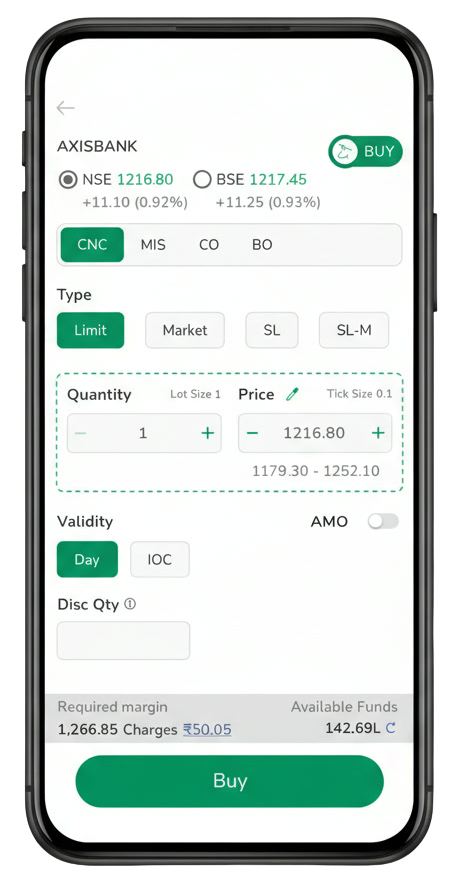
CNC, MIS or MTF: the product type decides everything else
It is a small dropdown and it changes what you pay, what you own at the end of the day, and who can close your position without asking. Get this one field right and most other mistakes become survivable.
Which product type applies
Two questions about what you intend to do. The matching column below gets highlighted. This describes how the product types work; it is not advice about what to buy or when.
You intend to keep the shares and you are paying in full, which is the plain, unleveraged case. The shares are delivered into your own demat account on the next trading day and stay there until you sell. There is no interest, no daily mark to market, no margin call and no auto square-off, ever. This is the product almost every long-term holding should use.
This explains which product type matches a stated intention. It takes no view on the security, the price or the timing, it does not consider your circumstances, and it is not investment advice. Leverage magnifies losses as well as gains.
Attribute CNC · Delivery MIS · Intraday MTF-Margin trading
| What it is for | Buying shares to keep | Buying and selling within the same session | Buying shares to keep, part funded by us |
| You pay | The full value, upfront | The margin required by the exchange, upfront | A stated portion; the rest is funded |
| Shares delivered | Yes, into your demat on settlement | No, the position is closed the same day | Yes, held as collateral until you pay or sell |
| Interest | None | None | Charged daily on the funded amount |
| Auto square-off | Never | Yes, before the session ends if you have not closed it | Only if the collateral falls short and you do not top up |
| Dividends and bonus | Yours, in full | Not applicable | Yours, subject to the pledge terms |
| Time horizon | Any, including decades | Hours | Days to months, while interest accrues |
| Main risk | The company or the market falls | A move against you is amplified and the clock runs out | Interest plus leverage; a fall costs more than the fall itself |
| Who it suits | Anyone building a holding | Someone actively trading with a written exit rule | Someone who understands financing cost and margin calls |
Converting a position
An intraday position can usually be converted to delivery before the square-off cut-off, provided you have the full amount to pay for it. The reverse is also possible on the same day.
Worth knowing: converting a losing intraday trade into a long-term holding is the oldest and most expensive habit in the market. A position becomes an investment because you decided so in advance, not because it is down.
The square-off clock
Intraday positions are closed automatically by our risk system shortly before the session ends, at whatever price the market gives at that moment. The exact cut-off is published in our policies and can be brought forward on volatile days.
Worth knowing: an auto square-off is not a stop loss. It fires on the clock, not on your price.
Pledging and collateral
Shares in your demat can be pledged to raise margin for other segments, and MTF holdings are themselves pledged in your favour with the depository. Every pledge needs your authorisation through an OTP sent by the depository, never by us.
Worth knowing: nobody can move securities out of your demat without either your OTP or a signed authorisation you gave knowingly.
Every order type, and the one thing each is actually for
Twelve entries, filtered by what you are trying to achieve rather than by their names. Open the ones that match your intention and ignore the rest.
Showing all 12 order types.
Market order
MARKETclick to know when to use it
Limit order
LIMITclick to know when to use it
Stop loss, limit
SLclick to know when to use it
Stop loss, market
SL-Mclick to know when to use it
Good till triggered
GTTclick to know when to use it
After-market order
AMOclick to know when to use it
Iceberg order
ICEBERGclick to know when to use it
Disclosed quantity
DQclick to know when to use it
Cover order
COclick to know when to use it
Bracket order
BOclick to know when to use it
Basket order
BASKETclick to know when to use it
Day, IOC and TTL
VALIDITYclick to know when to use it
Reading about orders is not the same as placing one
Open an account and place your first order at the smallest size you can. One real trade teaches more about spreads, triggers and settlement than any amount of reading, and at one share it costs almost nothing to learn.
The six stages your order passes through
Most of this is invisible and takes well under a second. Knowing the sequence is what lets you tell a rejection from a failure, and a pending order from a lost one.
The controls sitting between you and a runaway market
Most of the surprises a new investor meets are one of these six mechanisms doing its job. None of them is a malfunction, and all of them are published by the exchanges in advance.
Daily price bands
Each security has a band above and below the previous close beyond which orders are not accepted that day. Bands differ by security and are reviewed periodically by the exchange. A share that hits its upper band is locked: buyers queue and no seller appears.
What you see: an order rejected for being outside the price range, or a share frozen with an enormous pending quantity on one side.
Additional surveillance measures
Securities showing unusual price or volume behaviour are placed under graded surveillance by the exchanges. The consequences escalate by stage and can include a higher margin, a narrower price band, trade-for-trade settlement, or periodic call auction instead of continuous trading.
What you see: a much higher margin than expected, or a share that suddenly trades only in short auctions.
Trade-to-trade settlement
Some securities are placed in a segment where every trade must result in delivery. Intraday trading is not permitted at all: if you buy, you must take delivery and pay in full, and you can only sell what is already in your demat.
What you see: an intraday order refused, or a position that cannot be squared off on the same day.
Market-wide circuit breakers
If a benchmark index moves beyond a defined threshold in either direction, trading halts across the entire equity market for a set period, and beyond the largest threshold for the rest of the day. It applies to every security at once, including the derivatives segment.
What you see: the whole market stops. Nothing is wrong with your connection or with us.
Upfront margin, collected before the order
Regulation requires the full applicable margin to be available in your account before an order is sent, in every segment including intraday equity. A shortfall at any exchange snapshot attracts a penalty that is levied on us and passed on to you.
What you see: an order refused for insufficient margin even though the money is on its way in.
Auction for short delivery
If a seller fails to deliver the shares, the clearing corporation buys them in a separate auction and the defaulting seller bears the difference plus a penalty. A buyer who does not receive shares is compensated in cash under the exchange's close-out rules.
What you see: shares not credited on the expected day, followed by a cash credit instead. It is rare and it is handled.
The thresholds, stages and consequences of each mechanism are notified by the exchanges and SEBI and are revised from time to time. This page describes how the mechanisms work rather than their current numerical settings, which should be read from the exchange circular in force on the day.
Eight lines on a contract note, and only one of them is ours
Most of what is deducted from an equity trade never reaches the broker. Knowing who levies each line tells you which ones we can change and which we simply collect and pass on.
| Line on the contract note | What it is | Levied by | Where the current rate is published |
|---|---|---|---|
| Brokerage | Our fee for executing the order. Flat, whatever the order value. | Yukti | ₹20 per executed order |
| Securities transaction tax | A tax on the value of the transaction, charged differently for delivery and intraday. | Government | Notified rate, in the Finance Act |
| Exchange transaction charge | The exchange's fee for using its order book and matching engine. | NSE or BSE | Exchange circular, revised periodically |
| SEBI turnover fee | A regulatory levy on turnover, funding the regulator's oversight. | SEBI | SEBI circular |
| Stamp duty | A duty on the transfer of securities, charged on the buy side. | State | Uniform rates notified under the Stamp Act |
| Goods and services tax | Applied on brokerage and on the transaction and regulatory charges, not on the trade value. | Government | Prevailing GST rate |
| Depository charge | Charged when securities are debited from your demat account, per security per day. | CDSL and Yukti | Published tariff sheet |
| Demat maintenance | An annual charge for maintaining the demat account itself. | Yukti | Published tariff sheet |
A flat fee favours the larger order
Twenty rupees on a two thousand rupee purchase is one percent before anything else has been counted. On a fifty thousand rupee purchase it is four hundredths of a percent. The fee does not change; its weight does.
Practical effect: for small regular buys, accumulate and buy less often instead of many tiny orders.
The depository charge lands on the sell
Selling moves securities out of your demat, and the depository charges for that movement per security per day, whether you sold one share or a thousand. Selling five holdings on the same day costs five times as much as selling one.
Practical effect: it is small, it is genuine, and it is the charge people forget to count.
The spread is a cost too
The gap between the best buy and best sell price is not on any bill, but you pay it every time you use a market order. In a thinly traded share that gap can exceed every named charge on the contract note put together.
Practical effect: a limit order is the cheapest risk control available, and it costs nothing to use.
Statutory and exchange rates are set by the government, SEBI, the exchanges and the depository and are revised from time to time; the rate in force on your trade date applies. This page deliberately describes what each charge is rather than quoting a rate that would go out of date. The published tariff sheet and your contract note are the authoritative record.
How equity is taxed, in structure
Rates change with the Finance Act and have changed recently, so this describes the framework rather than the numbers.
Holding period decides the category
Listed shares held beyond the prescribed period produce long-term capital gains; held for less, short-term. The clock runs from the date of purchase, and where you bought the same share several times, the earliest units are treated as sold first.
Look up: the current holding period threshold and the rate for each category for the relevant financial year.
Delivery and intraday are taxed differently
A delivery trade produces a capital gain or loss. An intraday equity trade is treated as speculative business income, taxed at your slab rate, with its own rules on set-off. The same share, the same day, a different product type, an entirely different tax treatment.
Look up: how speculative losses may be set off and for how long they can be carried forward.
Dividends are your income
Dividends are added to your total income and taxed at your slab rate. The company deducts tax at source once its dividends to you cross the notified threshold in a year, and that deduction appears in your annual tax statement to be adjusted against the final liability.
Look up: the current threshold above which tax is deducted at source on dividends.
Losses can be set off and carried forward
A short-term capital loss can be set off against both short and long-term gains; a long-term loss only against long-term gains. Whatever remains is carried forward for a number of assessment years, but only if the return is filed by the due date.
Practical effect: filing late forfeits the carry-forward entirely, which is an avoidable and expensive mistake.
Use the capital gains statement
We generate a statement for each financial year showing realised gains, the holding period of each parcel and the split between categories. A profit figure on a dashboard is not computed on the basis the tax law uses and should never be used for a return.
Practical effect: download it, keep the contract notes, and hand both to whoever files for you.
We do not give tax advice
Your position depends on your total income, your residential status, the regime you have opted for and holdings we cannot see. We are a stock broker, not a tax adviser, and nothing here is advice on your own circumstances.
Practical effect: take the statement to a chartered accountant, especially in the first year you have sold anything.
Where your money and your shares actually sit
The protections below are not courtesies we offer. They are regulatory requirements, and each one is verifiable by you, independently of anything we tell you.
Your shares are in your name
Securities sit in a demat account opened with the depository in your own name, not in ours and not in a pooled account. We are the depository participant that services the account; we are not its owner.
Verify it yourself: the depository emails you a consolidated account statement directly. Open it.
Client funds are segregated
Money you transfer is held in designated client bank accounts, kept separate from our own funds, and cannot be used for our purposes. Client-level holdings and balances are reported to the exchanges regularly.
Verify it yourself: the exchanges send you an independent statement of your funds and securities balances.
Idle money is returned to you
Under the running account settlement requirement, funds not required as margin are transferred back to your own bank account at the prescribed interval. Your money does not sit with a broker indefinitely simply because you forgot about it.
Verify it yourself: a retention statement is issued explaining what was returned and what was kept, and why.
Nothing leaves your demat without your authorisation
A sale, a pledge or any other debit from your demat requires either a one-time password issued by the depository directly to you, or a demat debit and pledge instruction you signed knowingly. We cannot move securities on our own.
Verify it yourself: the OTP comes from the depository, never from us. Never share it with anyone, including someone claiming to be us.
Nomination is compulsory
Every account must carry a nomination or a recorded opt-out. It takes a minute and it is the difference between a family claiming securities in weeks and claiming them in years. Equally important and entirely voluntary: tell one person that the account exists.
Verify it yourself: the nominee's name appears on your account statement. Check that it is still the person you intended.
The Investor Protection Fund
Each exchange maintains a fund to compensate investors, up to a prescribed limit, where a member is declared a defaulter and legitimate claims cannot otherwise be met. It is a backstop of last resort, not an insurance policy against market losses.
Be clear: it protects against a broker's default, never against a share falling in price.
If something goes wrong, the escalation ladder
Use it in order. Each rung has a defined response time, and skipping a rung usually sends the complaint back to the one you skipped.
Write to the support desk with your client code and the specific trade or entry in question. If the answer does not satisfy you, escalate to the compliance officer whose name, email and phone number are published on this website and in your client kit.
Every exchange runs an investor grievance mechanism for complaints against its members. File with the exchange where the trade took place, attaching what you sent us and what we replied.
SCORES is SEBI's centralised platform for complaints against market intermediaries. It tracks the complaint, sets timelines for a response and keeps the record. Registering is free and you can follow the status yourself.
Where a grievance remains unresolved, the online dispute resolution mechanism offers conciliation and then arbitration, conducted online and against defined timelines, without requiring you to travel or to engage a lawyer.
Contact details, filing addresses and the current process for each stage are published on our website, on the exchange websites and by SEBI. The Investor Charter and the monthly complaint data we are required to disclose are linked in the footer of every page on this site.
An account you can audit from the outside
Your shares remain in your own demat account with the depository and your funds are maintained in a segregated client account with the exchanges. We do provide frequent statements with all the required information. We also provide online access of your account, so that all your important information always remains on your fingertips. Over and above that, Exchanges and Depositories also send you similar information directory to you, for cross verification.
The equity glossary
Every term you will meet on an order pad, a contract note or a statement, defined in one or two sentences. Type to search, or jump by letter.
All 64 terms.
An order placed when the market is shut and queued for the next session's opening. Always attach a limit price, because the opening minutes are the most volatile of the day.
A graded framework under which the exchanges place securities showing unusual price or volume behaviour into stages carrying higher margin, narrower bands or restricted trading.
The lowest price at which someone is currently willing to sell. Also called the offer. You buy at the ask and sell at the bid.
A separate session in which the clearing corporation buys shares a seller failed to deliver. The defaulting seller bears the price difference and a penalty.
Several orders assembled and sent as one instruction, so building or rebalancing a multi-holding portfolio takes one confirmation rather than many.
The highest price at which someone is currently willing to buy. The gap between the bid and the ask is the spread.
Free additional shares issued in a stated ratio. Your share count rises and the price falls proportionally, so the value of the holding is unchanged on the day.
The period during which a company closes its register to determine who is entitled to a corporate action. Related to, but not the same as, the record date.
An intraday instruction carrying an entry, a target and a stop loss together, with an option to trail the stop. When one exit fills, the other is cancelled.
A transaction in which the quantity exceeds a defined share of the security's traded quantity. It must be disclosed to the exchange, which publishes the details the same day.
An offer by a company to repurchase its own shares from shareholders, usually above the market price. Participation is optional and acceptance is proportionate.
The band above and below the previous close within which a security may trade on a given day. Orders outside the band are not accepted.
The entity that steps between buyer and seller after a trade, guaranteeing settlement so that neither side depends on the other performing.
Cash and carry: the product type for delivery. You pay in full and the shares are credited to your demat account. No square-off, no interest, no expiry.
A periodic statement sent to you by the depository listing everything you hold across demat accounts. It reaches you directly, independently of your broker.
The authoritative document issued for each trade day, listing every trade and every charge separately by name. Capital gains computations are built from these.
Anything a company does that changes what sits in your demat account or your bank account: a dividend, bonus, split, rights issue, buyback, merger or demerger.
An intraday order that compulsorily carries a stop loss, sent as one instruction, so the position cannot exist without protection.
Demat debit and pledge instruction: a limited authorisation you sign that lets securities be debited for settlement and pledge, replacing the older blanket power of attorney.
An account with a depository in which your securities are held in electronic form, in your own name. Your broker services it but does not own it.
The institution that holds securities in electronic form and records ownership. In India these are CDSL and NSDL.
The agent through whom you open and operate a demat account. Your broker is usually also your depository participant.
A field that shows only part of a large order in the public order book, subject to the exchange minimum, so the full size is not advertised.
A share of profit distributed in cash to shareholders, credited to the bank account linked to your demat. Taxed as income in your hands.
The dividend paid over a year expressed as a percentage of the share price. It moves when either the dividend or the price changes.
The first day on which a share trades without the entitlement to a declared corporate action. Buy on or after the ex-date and you do not receive it.
The nominal value of a share as stated in the company's records. It matters for splits and for some corporate actions and has little to do with the market price.
The portion of a company's shares actually available for trading, excluding promoter and locked-in holdings. Index weights are usually based on it.
What happens when a security reaches its circuit limit. Orders queue on one side and no counterparty appears, so the price cannot move further that day.
A standing instruction held with the broker that waits for your price over days or months within a validity period, rather than lapsing at the session close.
A framework placing securities with concerns around fundamentals or price behaviour into stages with progressively tighter trading restrictions.
A large order split into smaller visible legs released one after another, so the market sees only the tip while the rest is worked quietly.
The difference between the price you expected and the price you got because your own order moved the market. It is highest in illiquid securities.
A fund maintained by each exchange to compensate eligible investor claims up to a prescribed limit if a member is declared a defaulter. It does not cover market losses.
Initial public offering: the first sale of shares by a company to the public, after which the shares are listed and trade on an exchange.
The unique international identifier for a security. The same share has the same ISIN whether you bought it on NSE or BSE.
An order that states both quantity and the worst acceptable price. It fills at your price or better and otherwise rests in the order book.
How easily a security can be bought or sold without moving its price. High liquidity means tight spreads and deep quantities on both sides.
The price of the most recent trade. It is not the closing price, which the exchange computes as a weighted average near the end of the session.
The share price multiplied by the number of shares outstanding: what the market currently says the whole company is worth.
The list of pending buy and sell orders at each price level. Reading it before placing a large order tells you what your own order will do to the price.
An order that states quantity but no price. It fills immediately at whatever the order book offers, which may be well away from the last traded price.
Margin intraday square-off: the intraday product type. The position must be closed within the session and is squared off automatically if you do not.
Margin trading facility: shares are delivered to you but part of the purchase is funded by the broker, with interest charged daily and the holding pledged as collateral.
The person recorded to receive the securities in the event of the holder's death. It is compulsory to nominate or to record an opt-out.
A mechanism through which existing large shareholders sell part of their holding to the public on the exchange platform, within a defined window.
The exchange's live record of all pending orders, matched by best price first and, among equal prices, by which order arrived first.
Marking securities in your demat as security for a margin or a loan. It requires an OTP issued by the depository directly to you.
The fifteen minutes before the normal session, used to discover an opening price by call auction rather than continuous matching.
The date on which a company checks its register to decide who is entitled to a corporate action. You must be a holder by then.
An offer to existing shareholders to buy more shares at a stated price in proportion to their holding. The entitlement itself can usually be sold on the exchange.
A system in which trades of each day settle on a fixed number of days afterwards, rather than at the end of a fixed period. India uses a T plus one cycle.
SEBI's centralised online platform for lodging and tracking complaints against market intermediaries. Registering and filing are free.
A tax levied on the value of transactions in listed securities, charged at different rates for delivery and intraday trades and collected by the broker.
The completion of a trade: shares delivered to the buyer's demat account and money credited to the seller, on the next trading day under T plus one.
The gap between the best bid and the best ask. It never appears on a bill but you pay it every time you use a market order.
An order that stays dormant until a trigger price is reached, then goes to the exchange as either a limit order (SL) or a market order (SL-M).
A division of the face value so that one share becomes several at a proportionally lower price. Nothing about your ownership changes.
A personal identification number issued by the depository which, with an OTP, authorises a debit of securities from your demat account for a sale.
The record of trades actually executed for you, as opposed to the order book, which also contains orders that are pending, rejected or cancelled.
A segment in which every trade must result in delivery. Intraday trading is not permitted at all in a security placed there.
The total value traded in a security or a segment over a period. Not to be confused with volume, which counts shares rather than rupees.
The number of shares traded over a period. A price move on thin volume carries less information than the same move on heavy volume.
Volume weighted average price: the average price over a period weighted by the quantity traded at each price. Used as a benchmark for execution quality.
Commonly asked about equity
What exactly do I need to open an account?
click to see the answer
Can I sell a share the same day I buy it?
click to see the answer
Why was my order rejected when I had the money?
click to see the answer
What happens if I forget to close an intraday position?
click to see the answer
Is the same share the same on NSE and BSE?
click to see the answer
What is the difference between the last traded price and the closing price?
click to see the answer
Do I need to do anything when there is a bonus or a split?
click to see the answer
Are my shares safe if something happens to the broker?
click to see the answer
Does this page show live prices?
click to see the answer
Do you tell me which shares to buy?
click to see the answer